Hand Colored Images from the 1800's. How many of us have (or have seen) old photos that were 'hand colored'?
These are great.........And a reasonably easy to understand explanation of what a PHOTOCHROM is. They were willing to do a lot of work to get color. Why Are we so Lazy Now?
Didn't have any Photochromes lying around the house. So I'll just have to leave you with another 'lost' film type:
A Blog About Film Photography and Film Cameras: Traditional, Experimental, and Alternative Processes.
Saturday, August 9, 2014
Friday, August 8, 2014
Caribou Mine #3
The previous image had been cropped, although I did not show the before and after. Here I will show both:
One advantage of Medium and larger formats is that you have the resolution to 'zoom in by cropping'. Above the crop and below the full frame.
Wednesday, August 6, 2014
Caribou Mine #2
I love looking through window to see the other side. Click here to see one of my Favorite Ghost Town windows.
Below, another view of what was probably the Mine Office:
Monday, August 4, 2014
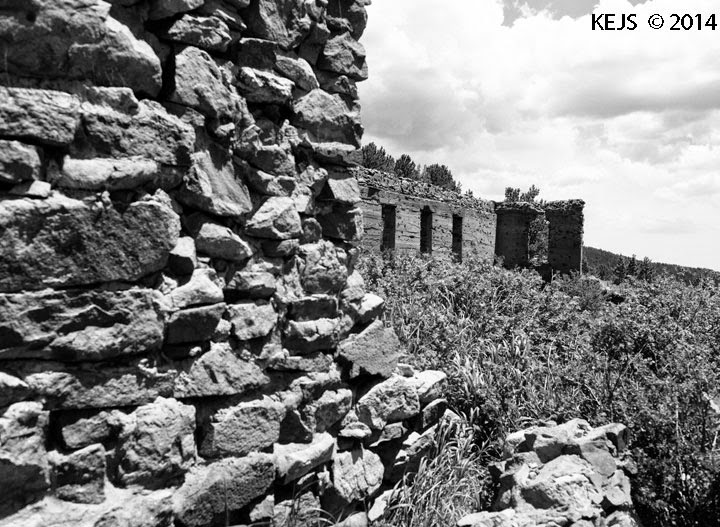
Caribou Mine, Colorado
We revisited the Caribou Mining District a few weeks ago. There is an active silver mine still onsite. But all that remains of the original town is a broken down cabin and two stone building ruins, that must have been Mine Offices.
As I have mentioned. The theme for the rest of the summer is Ghost Towns.......More Ghosts on the way.
Saturday, August 2, 2014
Saturdays Online: What Will Future Cinema Look Like?
And you ask what this has to do with still film photography?
Because left over motion picture film stock was repackaged and sold as 35mm film. Processing of this film type produced both a positive and a negative. For some of my old images using this film CLICK HERE. For better or worse, All of my early slide photography was done suing this film.
Hollywood is going digital and Kodak remains the only manufacturer of motion picture film. Some prominent Film Makers are negotiating a deal to keep motion picture film alive.
Why does all of this matter?
Q: Can you identify building in this photo?
Above, another 'Lost Forever Film' Kodak E100GX
Because left over motion picture film stock was repackaged and sold as 35mm film. Processing of this film type produced both a positive and a negative. For some of my old images using this film CLICK HERE. For better or worse, All of my early slide photography was done suing this film.
Hollywood is going digital and Kodak remains the only manufacturer of motion picture film. Some prominent Film Makers are negotiating a deal to keep motion picture film alive.
Why does all of this matter?
- Because small "mom & pop" local film festivals are being forces to spend up to $100K on new digital projection equipment. This is putting some Festival out of business.
- As fan of silent movies, I am aware of just what can be preserved (even fortuitously) by film, and later recaptured and restored. 90% of all Silent Movies ever made were lost because of the volatile nitrate films that were used. Digital preservation is just as "volatile".
- In a perverse twist Hollywood wants to record in digital and copy it to film for archival preservation. But if there is no motion picture film, what then?
Q: Can you identify building in this photo?
Subscribe to:
Posts (Atom)